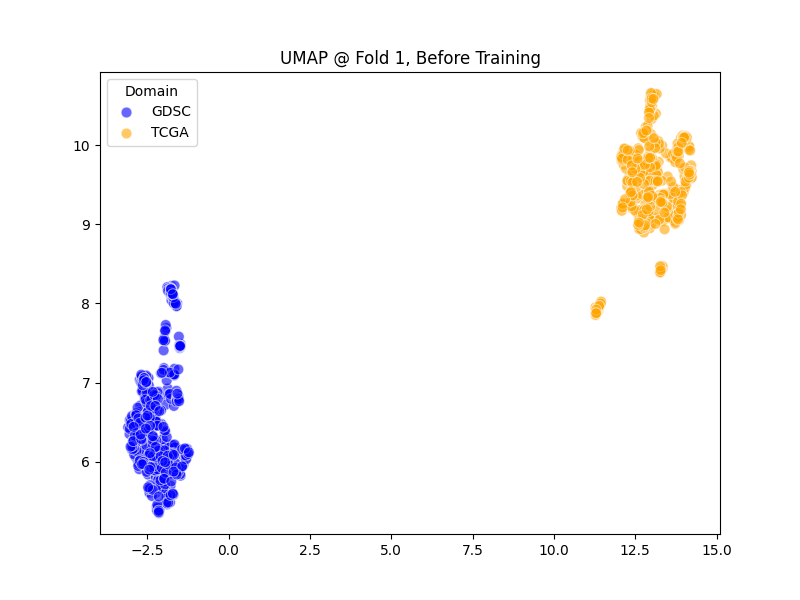
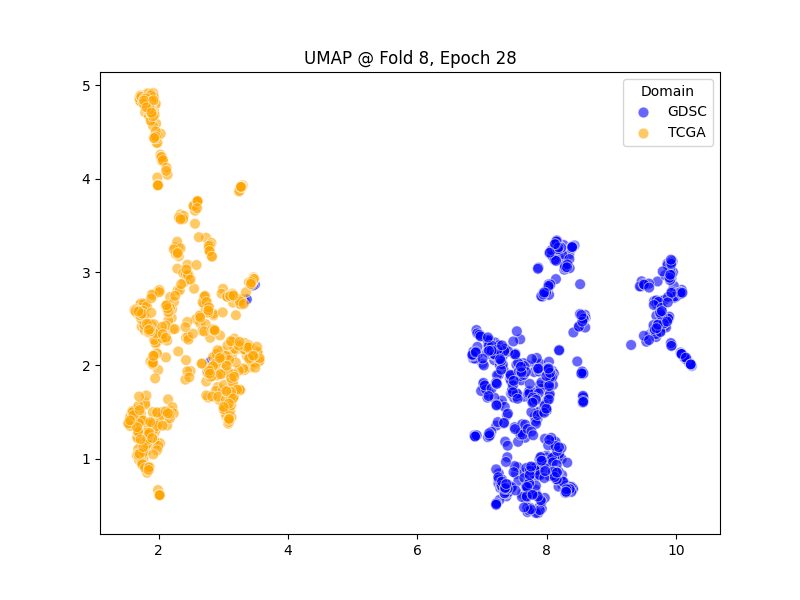
Problem. Cell-line (GDSC) and patient (TCGA) distributions differ markedly. A model optimized only for GDSC tends to learn domain-specific features; UMAP shows separated clusters, and predictions do not transfer to TCGA.
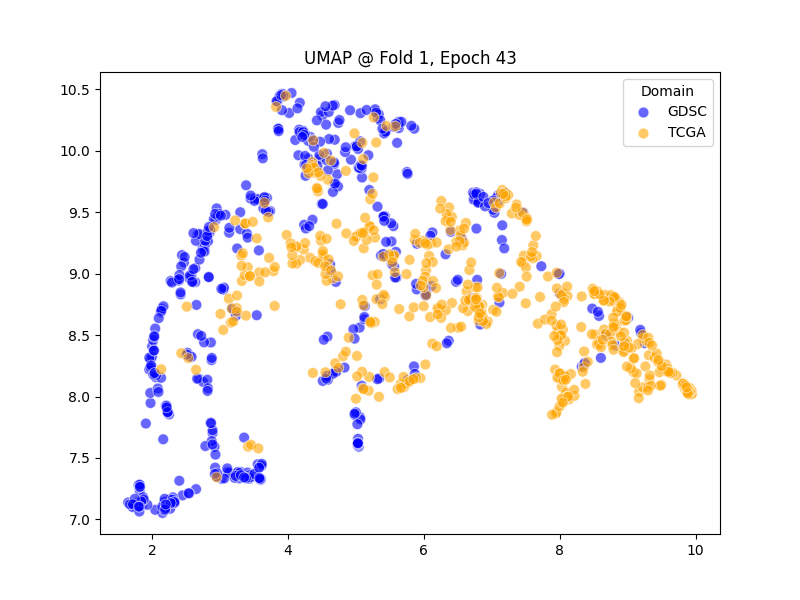
WANCDR. We adversarially align latent representations using a Wasserstein critic with unlabeled TCGA. This reduces the source–target domain gap while preserving predictive structure, improving clinical generalization, including for unseen drug–gene pairs.
Takeaway. DeepCDR reinforces the gap (good on GDSC, weak transfer), whereas WANCDR narrows it and performs robustly on TCGA.